Important: this article is general information, not medical advice. Get your doctor's approval before returning to exercise after birth. If you have diastasis, pain or pelvic floor issues, see a physiotherapist too.
After birth your body has been through a huge change. The abdominal muscles have stretched, the pelvic floor has worked hard, and sleep is short. Pilates is a gentle, controlled way to rebuild strength, as long as you start at the right time, with the right exercises and with the green light from your doctor.
Why move at all after birth
In 2020 the World Health Organization gave separate recommendations for pregnant and postpartum women for the first time. According to them, physical activity after birth is linked to a lower risk of postpartum depression. The recommendation is at least 150 minutes of moderate aerobic activity a week, combined with muscle-strengthening work and gentle stretching.3 The American College of Obstetricians and Gynecologists (ACOG) also notes that activity can help prevent depression after birth, and that women who exercised during pregnancy recover faster after it.1
What matters, though, is not how fast you get there but how. The WHO advises starting with small amounts and gradually increasing how often, how hard and how long you move.3
When to start
The answer depends on the birth. According to ACOG, after a healthy pregnancy and a normal vaginal delivery, many women can start gentle activity within a few days, or as soon as they feel ready. After a C-section or complications, ask your doctor when it is safe.2 The NHS notes that after a caesarean, exercising and carrying anything heavier than your baby may not be comfortable for 6 weeks or so.8 The postnatal check at 6–8 weeks is a good time to tell your doctor about any physical problem.7
“Gentle activity” in the first weeks doesn't mean a Pilates class. It means walks, breathing and pelvic floor exercises. At the studio we welcome new mothers once their doctor has cleared them, usually after that check.
- First weeks: breathing, pelvic floor, walks
If the birth was uncomplicated and your doctor or midwife agrees. The NHS suggests building up to 10 repeats of each pelvic floor exercise, at least 3 times a day.27
- Check-up at 6–8 weeks
Tell your doctor about pain, leaking, a heavy feeling or a visible gap. This is where you get the go-ahead for more structured exercise.7
- Once cleared: private Pilates
Deep core, bridge, posture, controlled breathing. The load goes up gradually.3
- Building the habit
Gradually towards 150 minutes of moderate activity a week and strength work on at least 2 days.2
- Jumping and running come last
The NHS advises avoiding high-impact exercise to start with. Decide when it's time with your doctor or a physiotherapist.7
Sources: ACOG [2], WHO [3], NHS [7]. A general guide, not a personal plan.
What diastasis recti is
Diastasis is a separation of the two straight abdominal muscles along the midline of the belly. It is very common. In a Norwegian study that followed 300 women through their first pregnancy, a separation of at least two finger-widths was found in 60% of them 6 weeks after birth and in about a third at 12 months.5 Most cases were mild, and women with and without diastasis reported lower back and pelvic pain equally often.5
Source: Sperstad et al., 2016 — 300 first-time mothers in Norway, diastasis = a gap of ≥2 finger-widths [5].
The NHS says the separation usually goes back to normal by the time your baby is 8 weeks old. If the gap is still obvious 8 weeks after the birth, contact your doctor, who can refer you to a physiotherapist for specific exercises.7
To be honest: evidence that particular exercises “close” diastasis is limited. In a randomised trial, a weekly supervised class (focused on pelvic floor strength) starting 6 weeks after birth did not reduce the number of women with diastasis.6 So the aim of Pilates here isn't to “melt the ridge” but to teach you to move with control and build strength without overloading your belly.
The pelvic floor
About one in three women have urinary incontinence after childbirth.4 Pelvic floor exercises are the main recommendation — the WHO says they can be done daily to reduce the risk.3 A large Cochrane review (46 trials, over 10,000 women) found that training started during pregnancy in women without symptoms lowers the risk of incontinence, including a few months after birth. The effect of training started only after birth is less certain, and the evidence there is limited.4 So if you already have symptoms, a pelvic floor physiotherapist is a better first step than a general class.
What to avoid at first
- sit-ups, planks and high-impact exercise — the NHS lists these specifically;7
- heavy lifting and straining;7
- lifting both legs while lying down and sharp twists, until you can control your core;
- jumping and running before your pelvic floor is ready.
What helps
- Calm breathing. Don't hold your breath. For pelvic floor exercises the NHS advises breathing normally and not pulling in your stomach as you squeeze.7
- Deep core activation. Small, controlled movements lying down, such as sliding one leg along the floor.
- Bridge. Strengthens the glutes and back, which work hard when you carry your baby.
- Posture. Feeding and carrying round the shoulders; upper-back exercises open them again. See our posture exercises.
When to stop
- mild muscle tiredness the next day;
- starting with 10 minutes — even that helps;2
- skipping a session after a sleepless night.
Why start with a private session
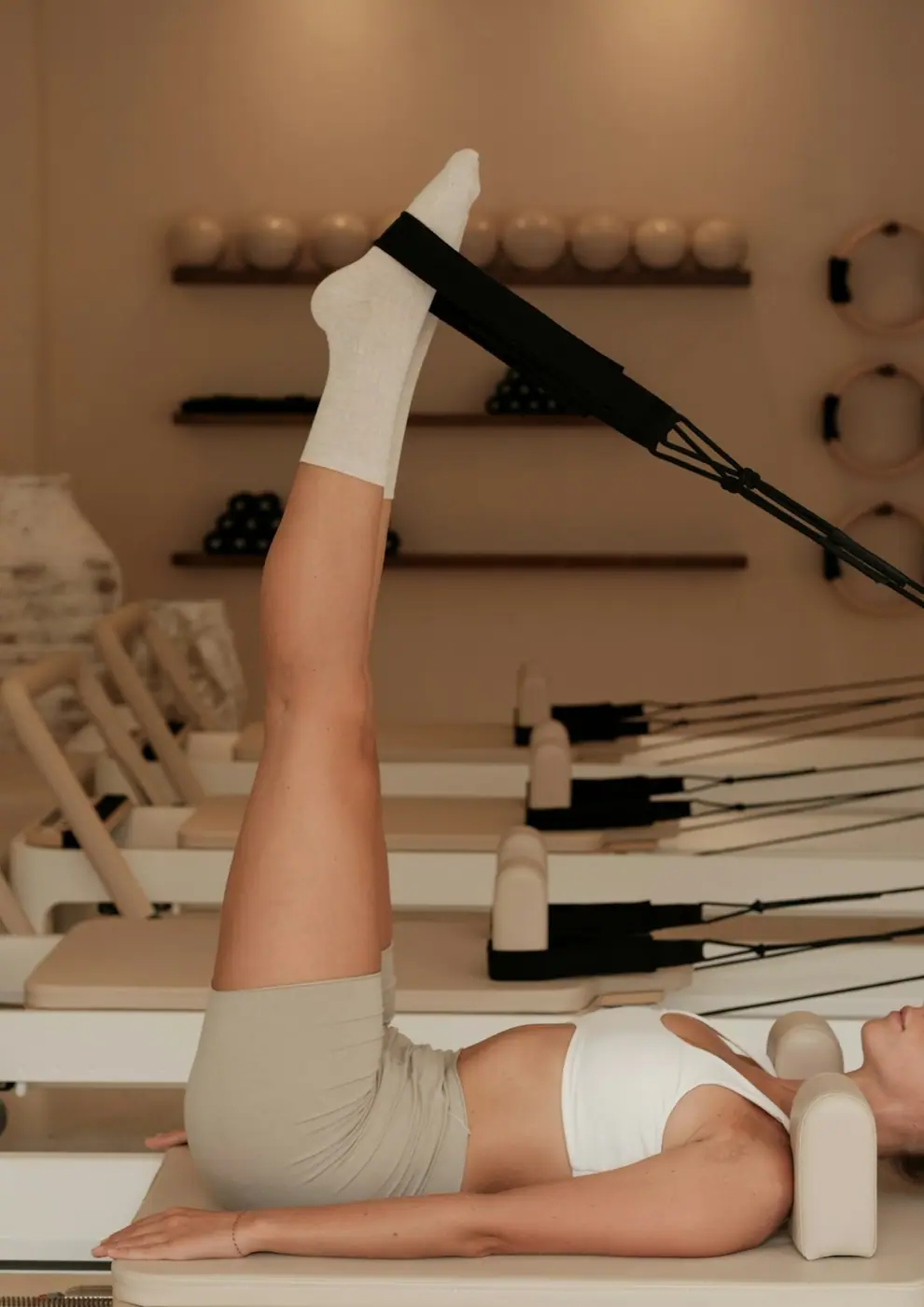
In a 1:1 Reformer session, Masha builds the programme around your body. She watches whether your belly domes, corrects your breathing and increases the load gradually. The Reformer's springs let the load be dosed very precisely, which makes the machine a good fit at the start. When you're ready, you can continue in a small group of up to 3. Prices are on the Prices page.
Frequently asked questions
When can I start Pilates after giving birth?
Usually after the check-up around 6 weeks after birth, with your doctor's approval. After a C-section the wait is often longer. You begin with breathing and gentle pelvic floor work.
Is Pilates suitable for diastasis recti?
Gentle, controlled Pilates can be part of your recovery, but the exercises must be adapted, and evidence that specific exercises close the gap is limited. Talk to a doctor or physiotherapist and start with a private session.
Can I do Pilates during pregnancy?
With your doctor's consent, yes. At Maison LÉA we offer a private programme adapted to pregnancy. Message or call us before your first class.
Sources
- American College of Obstetricians and Gynecologists (2020). Physical Activity and Exercise During Pregnancy and the Postpartum Period: ACOG Committee Opinion No. 804. Obstetrics & Gynecology, 135(4), e178–e188. doi:10.1097/AOG.0000000000003772
- American College of Obstetricians and Gynecologists (2022, reviewed 2024). Exercise After Pregnancy (FAQ131). acog.org
- Bull FC, Al-Ansari SS, Biddle S, et al. (2020). World Health Organization 2020 guidelines on physical activity and sedentary behaviour. British Journal of Sports Medicine, 54(24), 1451–1462. doi:10.1136/bjsports-2020-102955
- Woodley SJ, Lawrenson P, Boyle R, et al. (2020). Pelvic floor muscle training for preventing and treating urinary and faecal incontinence in antenatal and postnatal women. Cochrane Database of Systematic Reviews, 5, CD007471. doi:10.1002/14651858.CD007471.pub4
- Sperstad JB, Tennfjord MK, Hilde G, et al. (2016). Diastasis recti abdominis during pregnancy and 12 months after childbirth: prevalence, risk factors and report of lumbopelvic pain. British Journal of Sports Medicine, 50(17), 1092–1096. doi:10.1136/bjsports-2016-096065
- Gluppe SL, Hilde G, Tennfjord MK, et al. (2018). Effect of a Postpartum Training Program on the Prevalence of Diastasis Recti Abdominis in Postpartum Primiparous Women: A Randomized Controlled Trial. Physical Therapy, 98(4), 260–268. doi:10.1093/ptj/pzy008
- NHS (2026). Your post-pregnancy body. nhs.uk
- NHS (2023). Caesarean section: Recovery. nhs.uk
Sources last checked: 20 October 2026