Eight hours at the laptop, phone in hand, then the car. By the end of the day your head has drifted forward, your shoulders have rounded and your back feels stiff. Pilates is a lovely way to move and strengthen your body after a day like that. But before the exercises, some good news from the research: you don't need to sit “perfectly straight” all day.
What you feel after a day at the desk
- Your head drifts forward and your neck and upper back get tired.
- Your shoulders round and your chest feels “closed”.
- The front of your hips feels tight after hours of sitting.
- Your back feels stiff because it has stayed in one position for a long time.
All of this is normal and reversible. Your body isn't “broken”, it just wants to move.
“Sit up straight!” Why perfect posture is a myth
We've all heard it since childhood. A group of physiotherapists writing in the journal JOSPT point out that the belief that back pain comes from sitting, standing or bending “incorrectly” is very common, but there is no strong evidence behind it. Even so, a whole industry of posture-“correcting” products has grown around it.4
A large review of 41 systematic reviews reached a similar conclusion. Postures, sitting, bending and low back pain are sometimes linked, but there is no consensus that they cause it.5 And in a study of 1,108 seventeen-year-olds, researchers sorted their sitting posture into four groups, from upright to “slumped back with head forward”. The odds of neck pain or headache were the same across all groups.6
So what does this mean? You don't need to “hold” yourself upright all day or worry every time you sink into your chair. At the studio we say the best posture is your next one: changing position and moving help more than one perfectly “correct” pose held for hours.
What research says about Pilates and posture
That doesn't mean posture doesn't matter. If you want to feel more upright, stronger and more mobile, exercise works. A 2024 systematic review pooled 13 studies with 783 participants in total and concluded that Pilates improves posture measures in the neck, upper back and lower back.1 Most programmes lasted 8–16 weeks, most often with 2 sessions a week.1
The evidence is moderate, though. Only 6 of the 13 studies were of good quality, most participants were young women, and the authors themselves call for larger, more rigorous research.1
Number of studies by PEDro scale rating. Source: Li et al., 2024 [1]
For forward head posture the data are clearer. A meta-analysis of 7 randomised trials with 627 participants found that exercise improves the angle between the head and neck and moderately reduces neck pain.3 In one randomised trial with 46 people, clinical Pilates improved head position and deep neck muscle strength more than home exercises. Pain and daily function, however, improved equally in both groups.2
| Claim | What studies show | Certainty |
|---|---|---|
| “Bad posture causes pain” | Sometimes linked, but causation not shown 56 | No consensus |
| “Pilates improves posture” | Improvements in most of 13 studies, of mixed quality 1 | Moderate |
| “Exercise brings the head back” | Large effect on neck angle across 7 randomised trials 3 | Stronger |
| “Pilates beats everything else for neck pain” | In a randomised trial, pain fell as much as with home exercises 2 | Limited |
5 exercises you can do at home
The aim isn't to “fix” your posture but to mobilise your upper back, strengthen your back and glutes and loosen your hips. The whole sequence takes about 10 minutes.
1. Chin nod. Lie on your back with knees bent. Gently tuck your chin as if holding a peach under it and lengthen the back of your head towards the floor. Hold for 5 seconds. 8 reps.
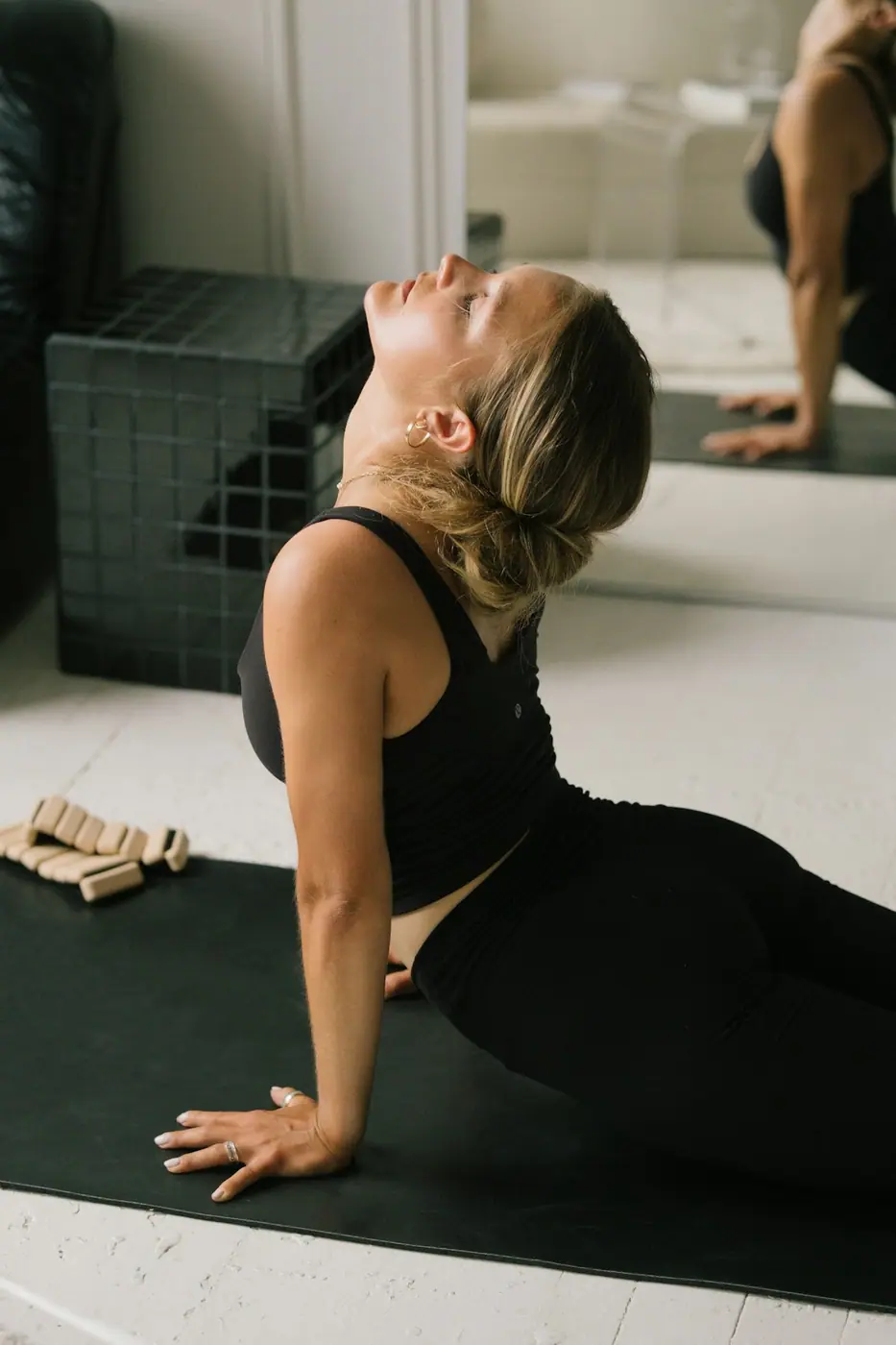
2. Swan prep. Lie on your front with palms beside your shoulders. As you exhale, lift your chest slightly while sliding your shoulder blades down towards your waist. Keep your gaze on the floor. 6–8 reps.
3. Clam. Lie on one side with knees bent and feet together. Lift the top knee without rolling your pelvis back. It wakes up the glutes, which stabilise the pelvis. 10 reps per side.
4. Seated spine twist. Sit with legs straight and arms out to the sides. Grow tall, and as you exhale rotate your upper body, then return to centre. 5 per side. It restores mobility in the upper back.
5. Half-kneeling hip flexor stretch. One knee on the floor, the other foot in front. Tuck your tailbone slightly and shift your weight forward until you feel a stretch at the front of the hip. 30 seconds per side.
Small habits at your desk
The 2020 WHO guidelines recommend that all adults reduce the time they spend sitting and get at least 150–300 minutes of moderate activity a week. Researchers haven't set an exact “safe” number of sitting hours, so there is no magic number. Simply put, the more often you get up, the better.7 Here's a short break we recommend to our clients:
- Stand up every 30–45 minutes
Even for a minute: to the window, for water, up the stairs. Set a quiet reminder on your phone.
- Change position
Lean back, then sit on the edge of your chair, then stand while you're on the phone. Variety is what matters, not the “ideal” pose.
- Two or three breaths “into the ribs”
Place your palms on the sides of your ribs and breathe so you feel them widen. Your shoulders will relax on their own.
- Seated chin nod
Lengthen the back of your head upwards and gently tuck your chin. 5 reps, without straining.
- Open your chest
Clasp your hands behind your back or hold the chair back, slide your shoulder blades down and lift your breastbone slightly. Hold for 3 breaths.
Also put your screen at eye level and your feet flat on the floor. It makes sitting more comfortable, even if it isn't a “cure” for pain.
Why the Reformer helps even more
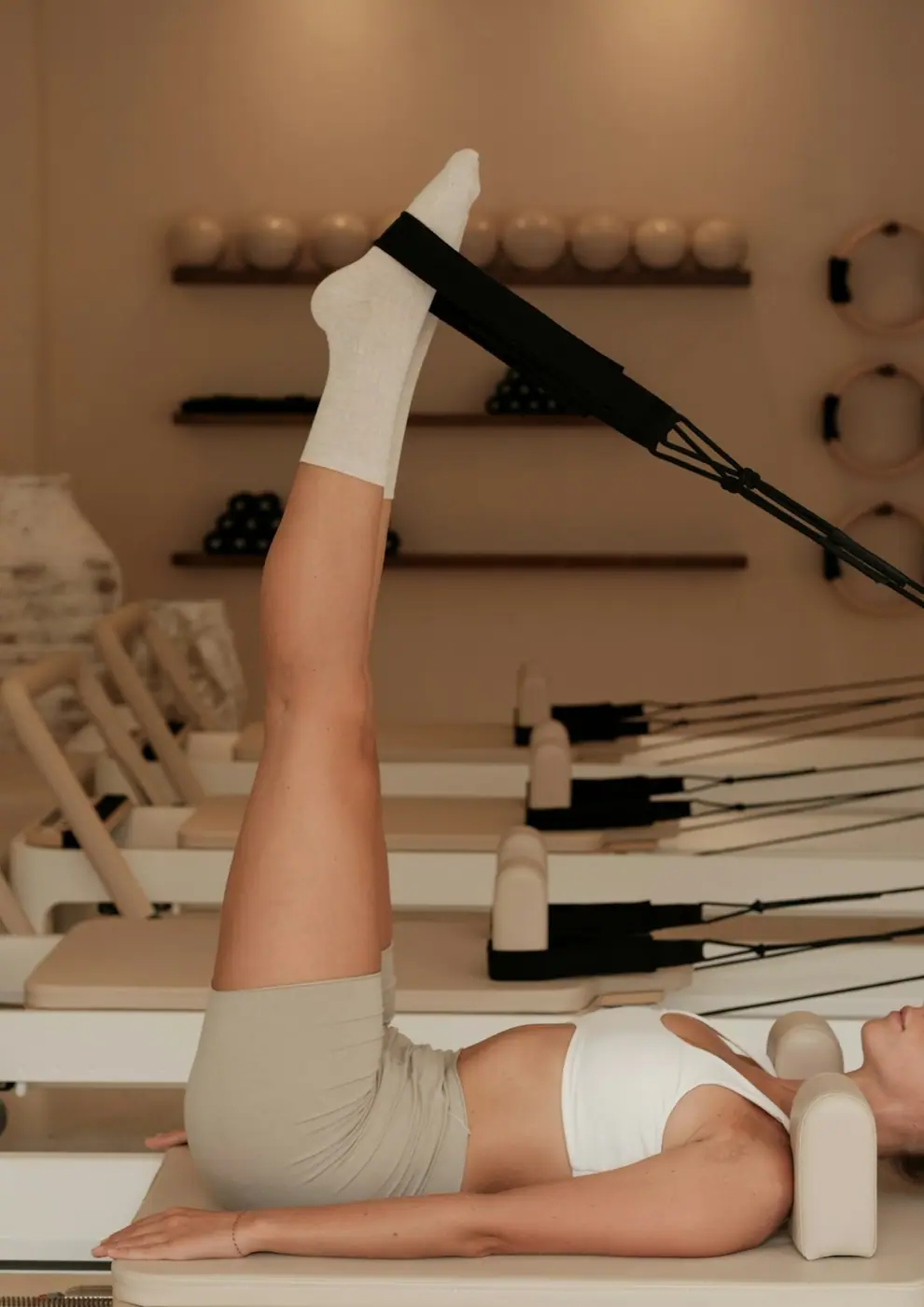
WHO recommends regular muscle-strengthening activity at every age.7 The Reformer is a convenient way to do it: the springs give resistance and feedback. You feel straight away if one side works harder, or if your back is doing your core's job. In a small group of up to 3, Masha corrects your movement on the spot and picks exercises for your upper back, glutes and hips. If your lower back hurts, see also where to start.
Frequently asked questions
How long does it take to improve posture with Pilates?
Many people feel looser within the first few weeks. In studies of Pilates and posture, programmes usually last 8–16 weeks, most often with 2 sessions a week1, so give yourself at least 2–3 months of regular practice.
Does Pilates help with neck pain?
Exercise in general moderately reduces neck pain in people with forward head posture.3 Pilates is a good option, but in one trial it did not reduce pain more than home exercises.2 What matters most is moving regularly. For strong or lasting pain, or numbness, see a doctor first.
Can I do these exercises every day?
Yes. The five exercises are gentle and take about 10 minutes. You can do them in the morning or after work.
Sources
- Li F, Omar Dev RD, Soh KG, et al. (2024). Effects of Pilates on Body Posture: A Systematic Review. Archives of Rehabilitation Research and Clinical Translation, 6(3), 100345. doi:10.1016/j.arrct.2024.100345
- Hürer C, Angın E, Tüzün EH (2021). Effectiveness of clinical Pilates and home exercises in sagittal cervical disorientation: randomized controlled study. Journal of Comparative Effectiveness Research, 10(5), 365–380. doi:10.2217/cer-2020-0186
- Sheikhhoseini R, Shahrbanian S, Sayyadi P, et al. (2018). Effectiveness of Therapeutic Exercise on Forward Head Posture: A Systematic Review and Meta-analysis. Journal of Manipulative and Physiological Therapeutics, 41(6), 530–539. doi:10.1016/j.jmpt.2018.02.002
- Slater D, Korakakis V, O'Sullivan P, et al. (2019). “Sit Up Straight”: Time to Re-evaluate. Journal of Orthopaedic & Sports Physical Therapy, 49(8), 562–564. doi:10.2519/jospt.2019.0610
- Swain CTV, Pan F, Owen PJ, et al. (2020). No consensus on causality of spine postures or physical exposure and low back pain: A systematic review of systematic reviews. Journal of Biomechanics, 102, 109312. doi:10.1016/j.jbiomech.2019.08.006
- Richards KV, Beales DJ, Smith AJ, et al. (2016). Neck Posture Clusters and Their Association With Biopsychosocial Factors and Neck Pain in Australian Adolescents. Physical Therapy, 96(10), 1576–1587. doi:10.2522/ptj.20150660
- Bull FC, Al-Ansari SS, Biddle S, et al. (2020). World Health Organization 2020 guidelines on physical activity and sedentary behaviour. British Journal of Sports Medicine, 54(24), 1451–1462. doi:10.1136/bjsports-2020-102955
- World Health Organization (2024). Physical activity (fact sheet). who.int
Sources last checked: 20 October 2026