Reformer Pilates has become one of the most popular ways to train in Sofia. New studios keep opening, and choosing one isn't easy. Here's what's worth knowing before you book your first class: what the machine does, what research actually says about Pilates, what it costs with us and how to tell a good studio from an average one.
What Reformer Pilates is
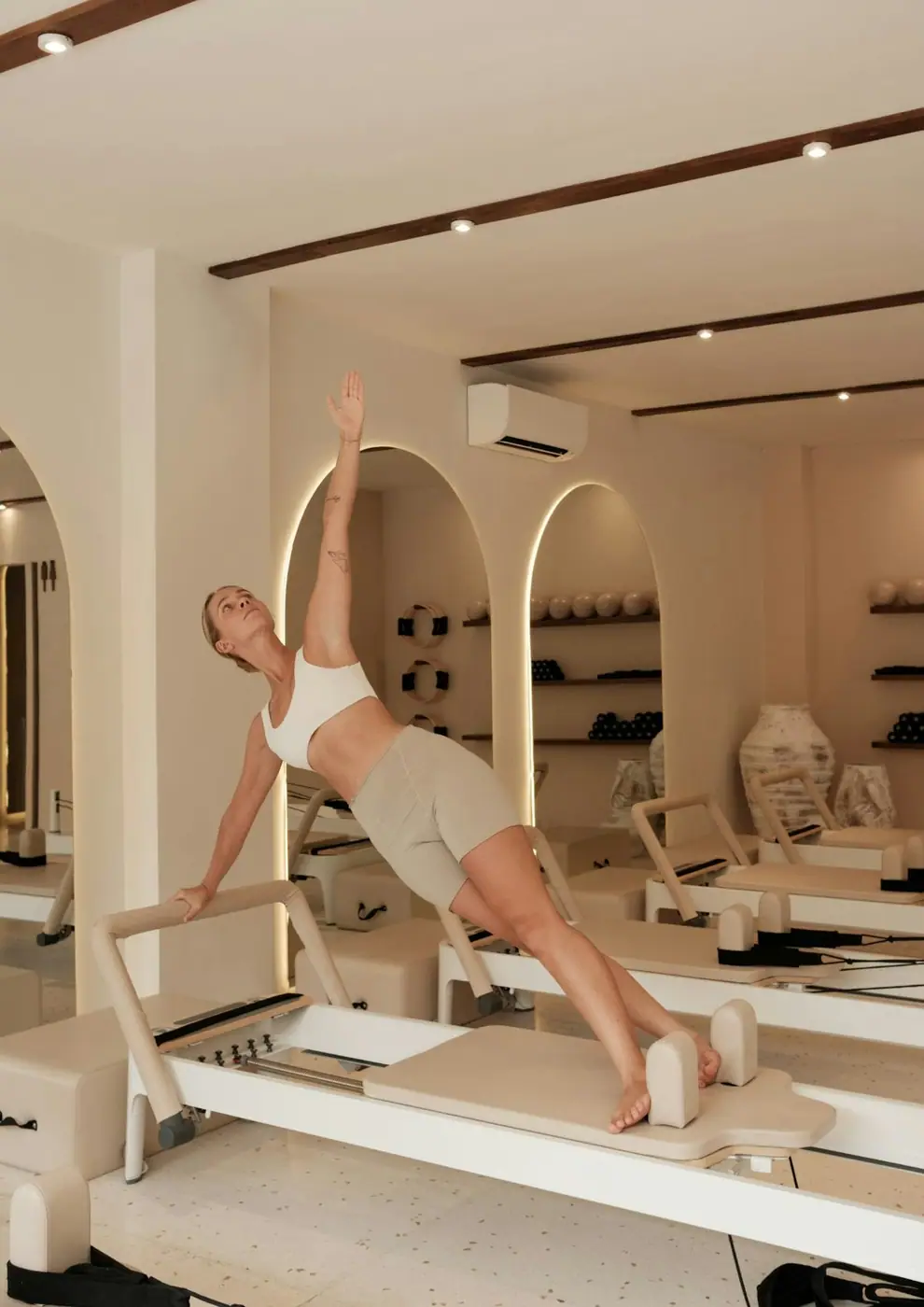
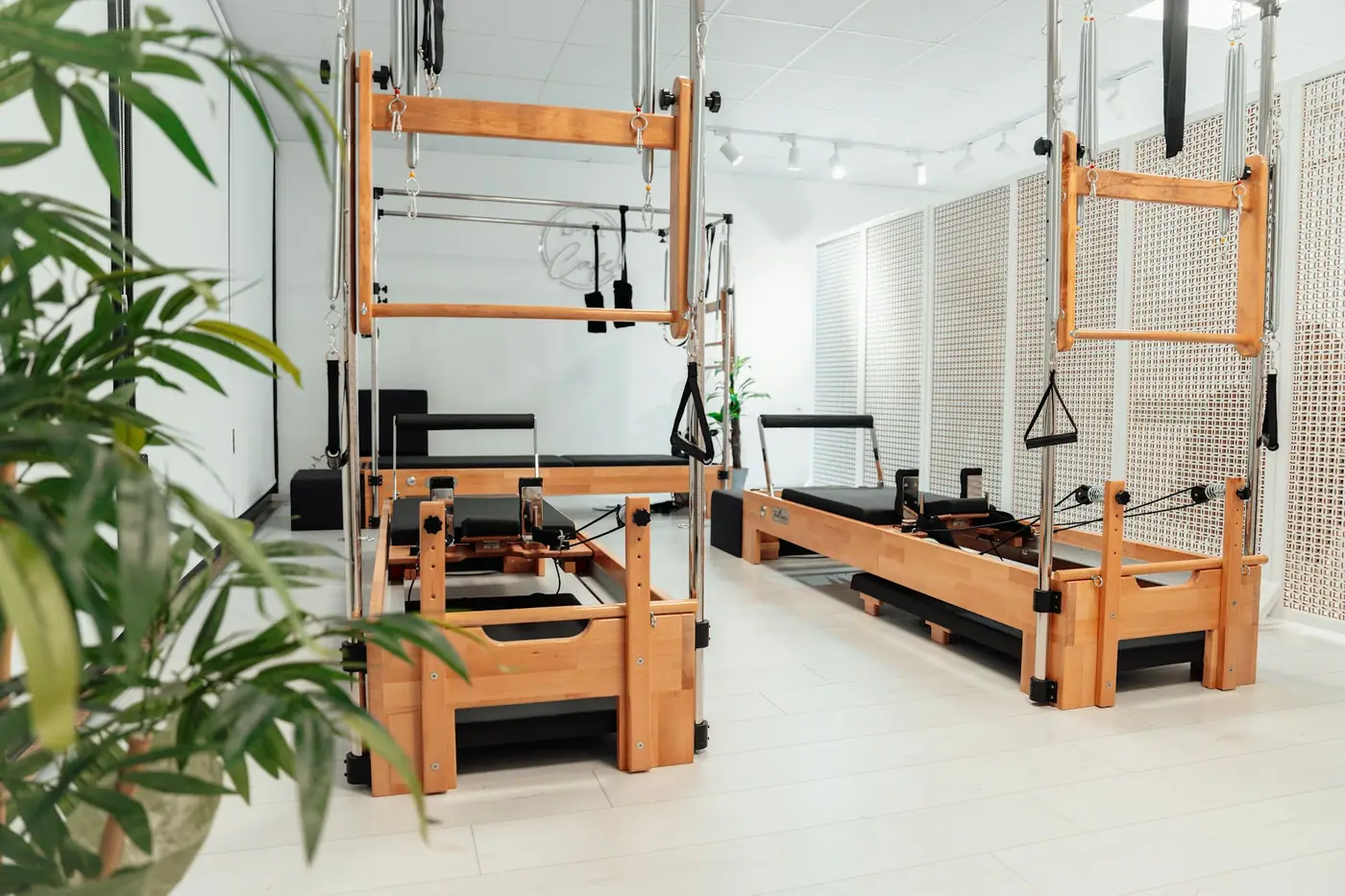
The Reformer is a machine with a sliding carriage, springs and straps. The springs can support you when a movement is hard, or add resistance when you want more strength. That's why the same class can suit both beginners and people who have trained for years. The principles are the same as in classic Pilates: controlled movement, breathing, a strong centre and good posture. Read more about how it differs from mat Pilates in Reformer or Mat.
Why it's worth moving more, especially in Bulgaria
The World Health Organization's 2020 guidelines say adults should do 150–300 minutes of moderate-intensity activity a week (or 75–150 minutes of vigorous activity), plus muscle-strengthening activities that work all major muscle groups on 2 or more days a week.1 Worldwide, almost a third of adults don't reach the recommended level.2
In Bulgaria the picture is less encouraging. In the EU's 2022 Eurobarometer survey on sport, 61% of respondents in Bulgaria said they never exercise or play sport, compared with 45% across the EU. Only 21% did so at least once a week, against 38% in the EU as a whole.3 The good news is that the share of Bulgarians who never exercise has fallen by 7 points since 2017.3
Source: Special Eurobarometer 525, fieldwork April–May 2022, 26,578 people interviewed in the EU. "At least once a week" combines "regularly" (5+ times a week) and "with some regularity" (1–4 times a week). [3]
A Reformer class works the legs, glutes, back, core and arms against spring resistance, so it can count as one of your strength days. Two classes a week, plus walking or cycling on other days, already gets you a good way towards the guidelines.
What the research says about Pilates
Most reviews look at Pilates as a method, not at the Reformer on its own. Here's what they found, without the marketing gloss:
| Outcome | What the reviews found | How strong |
|---|---|---|
| Flexibility and dynamic balance | Improved in healthy adults (16 trials) 4 | Rated strong, but the trials were of low methodological quality |
| Muscular endurance | Improved in healthy adults 4 | Moderate |
| Strength | About the same as other forms of exercise 5 | Low to very low certainty |
| Older adults (60+) | Better mobility, less sideways sway and less fear of falling 6 | No high-quality evidence yet that it prevents actual falls |
| Chronic low back pain | Ranked highest of all exercise types for reducing pain and disability (118 trials, 9,710 people) 7 | A ranking from a network meta-analysis, not a guarantee for every person |
In other words, Pilates isn't magic, and it isn't "better" than every other kind of training. Its real strength is that it's a controlled, joint-friendly way to build strength and mobility that many people enjoy enough to keep doing. In the back-pain analysis, the most helpful programmes included 1–2 Pilates or strength sessions a week.7 If you have pain or a health condition, check with your doctor first and tell your instructor before class.
Classes at Maison LÉA
- Reformer Foundations (50 min) — the basics: breathing, core, how the machine works. The best first class.
- Reformer Flow (50 min) — a smooth full-body class.
- Reformer Sculpt (45 min) — more dynamic, with more repetitions and strength work.
- Pilates Mat (55 min) — classic Pilates on the mat.
- Private Reformer (55 min) — a 1:1 session built around you.
What it costs
| Format | 1 visit | 4 visits | 8 visits |
|---|---|---|---|
| Reformer group | €25 | €95 | €195 |
| Reformer private | €50 | €195 | €395 |
| Pilates Mat group | €15 | €55 | €115 |
Passes are valid for 1 month from purchase, and cancellation is free up to 12 hours before class. The studio doesn't accept MultiSport. Current prices are always on the Prices page.
How to choose a studio: 6 questions
Whichever studio you pick, the result depends mostly on one thing: whether you'll keep going. These questions help you find a place where that's easy.
- How many people are in a group?
The smaller the group, the more corrections you get. Our Reformer groups have up to 3 people, each on their own machine.
- Is there a beginners' class?
A good start is half the result. A dedicated intro class teaches you the machine before you speed up.
- Is the instructor certified?
Ask where they trained and how much experience they have, and whether they adapt exercises for injuries, pregnancy or back pain.
- What's the cancellation policy?
12 hours is fair to both sides.
- How long is a pass valid?
And how many visits will you really use in that time. Two a week fits both an 8-visit monthly pass and the strength-day guideline.
- Is it easy to get to?
A studio near home or work means you'll actually go regularly.
Where we are
Maison LÉA is at 22 Todor Nedkov St, Malinova Dolina, close to Simeonovo, Studentski Grad and Business Park Sofia. There's usually free parking on the street outside. We're open Monday to Friday 8:00–21:00, Saturday 8:30–13:00 and Sunday 9:30–12:30. Directions are on the Contact page.
Frequently asked questions
How much does Reformer Pilates cost at Maison LÉA?
A group Reformer class is €25 per visit, a 4-visit pass is €95 and an 8-visit pass is €195. A private session is €50 per visit.
Do I need experience for Reformer Pilates?
No. We recommend starting with Reformer Foundations, where we teach the basic movements, breathing and how the machine works.
Do you accept MultiSport?
No, the studio doesn't accept MultiSport. You can pay for a single visit or a 4- or 8-visit pass.
Sources
- Bull FC, Al-Ansari SS, Biddle S, et al. (2020). World Health Organization 2020 guidelines on physical activity and sedentary behaviour. British Journal of Sports Medicine, 54(24), 1451–1462. doi:10.1136/bjsports-2020-102955
- World Health Organization. Physical activity. Fact sheet (accessed 20 October 2026). who.int
- European Commission (2022). Special Eurobarometer 525: Sport and physical activity. Fieldwork April–May 2022. doi:10.2766/356346
- Cruz-Ferreira A, Fernandes J, Laranjo L, et al. (2011). A systematic review of the effects of Pilates method of exercise in healthy people. Archives of Physical Medicine and Rehabilitation, 92(12), 2071–2081. doi:10.1016/j.apmr.2011.06.018
- Pinto JR, Santos CS, Souza Soares WJ, et al. (2022). Is pilates better than other exercises at increasing muscle strength? A systematic review. Heliyon, 8(11), e11564. doi:10.1016/j.heliyon.2022.e11564
- da Silva LD, Shiel A, McIntosh C (2021). Pilates Reducing Falls Risk Factors in Healthy Older Adults: A Systematic Review and Meta-Analysis. Frontiers in Medicine, 8, 708883. doi:10.3389/fmed.2021.708883
- Fernández-Rodríguez R, Álvarez-Bueno C, Cavero-Redondo I, et al. (2022). Best Exercise Options for Reducing Pain and Disability in Adults With Chronic Low Back Pain: Pilates, Strength, Core-Based, and Mind-Body. A Network Meta-analysis. Journal of Orthopaedic & Sports Physical Therapy, 52(8), 505–521. doi:10.2519/jospt.2022.10671
Sources last checked: 20 October 2026